
Twelve Years on One Coin: Why an LTC Miner Should Count the Second Stream
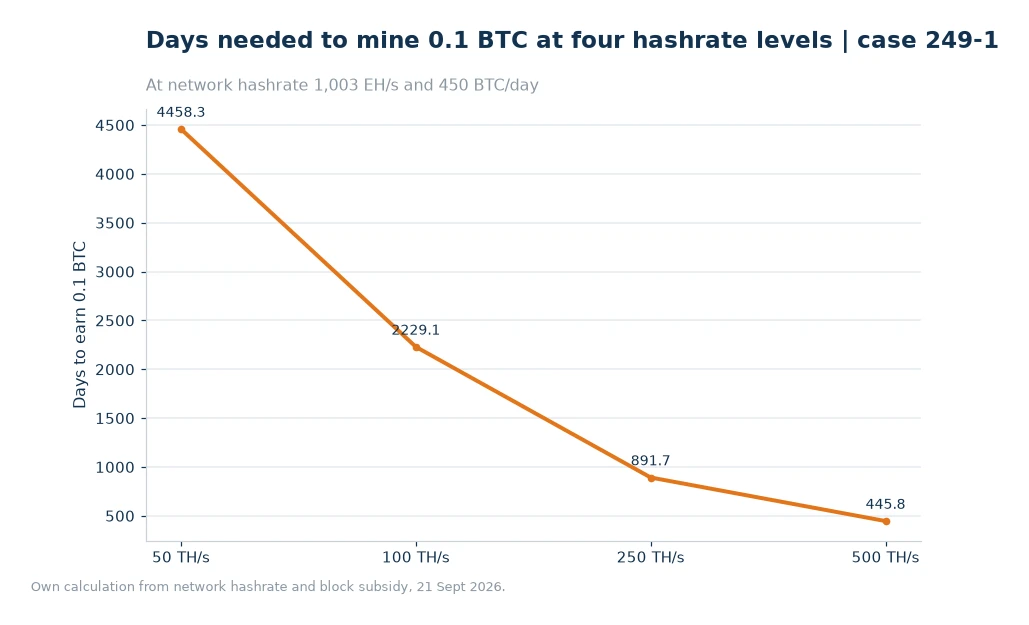
Measured against Bitcoin's issuance, 0.1 BTC takes 4,458.3 days at 50 TH/s, 2,229.1 at 100 TH/s, 891.7 at 250 TH/s and 445.8 at 500 TH/s on the 21 September 2026 network. That is twelve years at the bottom of the range and a bit over one at the top — a spread wide enough to make the unit of account the first decision, not the last. Scrypt hardware earns LTC, and merged mining adds a second coin to the same work.

Key takeaways
- 0.1 BTC takes 4,458.3 days at 50 TH/s but 445.8 days at 500 TH/s, a tenfold change from hardware alone.
- Scrypt machines are paid in LTC, so a BTC-denominated goal is a conversion rather than a direct output.
- Merged mining with DOGE adds a second revenue stream to the same hashing work.
- At LTC $59.32, 0.1 BTC is worth about 142.8 LTC, which is a clearer target for a Scrypt operator.
The Unit You Save In Decides the Plan
Every mining plan contains a hidden choice: the currency in which success is measured. An operator who saves in BTC will judge an LTC machine by how fast it produces bitcoin, and that judgement depends on a conversion rate that has nothing to do with the machine. An operator who saves in LTC judges the same machine by a number it actually produces.
The difference is not cosmetic. A target expressed in the wrong unit can make a sensible purchase look hopeless, or a poor one look adequate, purely because the two coins moved against each other during the measurement period. Fix the unit first, then choose the hardware.
What the Bitcoin Yardstick Shows
The chart below applies a Bitcoin-denominated goal to four hash rates, using Bitcoin's own issuance and network total. It is a yardstick rather than a forecast: it answers how long a fixed amount of BTC would take if the same share were working on the Bitcoin network. For an LTC operation, the value is comparative — it shows how much calendar a given amount of hash rate buys when the target is priced in BTC.
The answer is uncomfortable at the low end. Fifty terahash needs more than twelve years to reach 0.1 BTC, which is longer than most hardware survives. At 500 TH/s the same goal takes 445.8 days, just over fourteen months. Scrypt equipment is normally quoted in gigahash, so the reader should treat these figures as a unit exercise, not as a description of a typical LTC rig.
Merged Mining Changes the Revenue Mix
LTC blocks carry a second chain's work through merged mining, so the same submission can earn DOGE alongside the LTC reward. For the operator this means the income statement has two lines where a single-coin pool would have one, and the second line moves with a different market.
That has two practical consequences. First, a target set in LTC alone ignores part of the revenue, which understates the operation. Second, a target set in BTC has to absorb two conversion rates instead of one, which makes the result noisier and harder to attribute. Neither problem exists if the goal is written in LTC and the DOGE stream is treated as a bonus that can be converted when it accumulates.
The ViaBTC LTC Mining Pool page is where the share accounting for both chains appears; it is worth reading before the first payout rather than after.
LTC at $59.32 and the Coin You Actually Hold
At $59.32 per LTC and $84,692 per BTC, one bitcoin is worth about 1,427.7 LTC. That makes 0.1 BTC roughly 142.8 LTC, and 0.01 BTC about 14.3 LTC. An operator who thinks in those terms can compare a hardware quote with a coin target directly, without passing through a dollar figure that changes every hour.
It also makes the target honest about custody. A miner who is paid in LTC holds LTC until a conversion happens; until then, the BTC figure is a valuation, not a balance. Writing the goal in the coin held removes that ambiguity and makes the statement the source of truth.
Pool Readings for a Scrypt Account
Two numbers on the pool page do most of the diagnostic work. Pool Hashrate tells you what share of the pool your machines represent; a drop against your own dashboard usually means a worker stopped rather than that the pool changed. Pool Luck explains why a PPLNS account can have a quiet week with everything working correctly.
For a merged-mining account, check that both revenue lines appear in the statement. A missing DOGE line is a configuration question, not a hardware fault, and it is much easier to spot in the first week than after a quarter of production.
The multi-currency wallet keeps both balances in the same account, which is the simplest way to see the split without exporting anything.
Setting the Target in the Right Coin
Pick the coin you intend to hold, then set the target in that coin. If the answer is LTC, the hardware decision becomes a comparison between machines that all produce the same unit, and the conversion rate stops distorting the ranking. If the answer is BTC, accept that the plan includes an exchange-rate assumption and review it as often as the difficulty.
The table converts the four hash rates into calendar time and shows how much of a four-year hardware cycle each plan consumes. That last column is the one that decides whether a purchase is a plan or a hope.
| Hash rate | Days to 0.1 BTC | Months | Share of four years |
|---|---|---|---|
| 50 TH/s | 4,458.3 | 146.7 | 305% |
| 100 TH/s | 2,229.1 | 73.3 | 153% |
| 250 TH/s | 891.7 | 29.3 | 61% |
| 500 TH/s | 445.8 | 14.7 | 31% |
Worked example
Take the 50 TH/s column and carry it to a calendar and a coin balance.
- Daily issuance: 144 blocks × 3.125 BTC = 450 BTC.
- Per terahash: 450 ÷ 1,003,000,000 = 0.00000044865 BTC.
- At 50 TH/s: 0.00002243 BTC a day.
- 0.1 ÷ 0.00002243 = 4,458.3 days.
- 4,458.3 ÷ 365 = 12.21 years, or 146.7 months.
- Against a four-year hardware cycle of 1,461 days: 4,458.3 ÷ 1,461 = 3.05, so the plan spans three cycles.
- At 500 TH/s the same target takes 445.8 days, or 1.22 years and 31% of one cycle.
- Converting 0.1 BTC at the 21 September price: 0.1 × 84,692 = $8,469.20; divided by 59.32 gives 142.77 LTC.
Frequently asked questions
Should an LTC miner set goals in BTC or LTC?
In the coin the operation actually holds. LTC goals match the payout, while BTC goals add an exchange-rate assumption that can dominate the result and make a working machine look idle during a currency move.
How does merged mining affect the target?
It adds a DOGE stream to the LTC reward from the same work, so the operation earns more than an LTC-only estimate suggests. Treat the second stream as extra output and convert it when it accumulates rather than including it at a fixed rate.
Why use a Bitcoin chart for a Scrypt pool?
Because it is a common yardstick with published inputs. It shows how much calendar a given hash rate buys when measured in BTC, which is useful for comparison, not as a prediction of LTC output.
Write the Goal in the Coin You Keep
Choose the unit, write the target, and put the hash rate beside it. If the calendar that results is longer than the hardware will last, the target is wrong for the machine, not the other way around. The Profit Calculator can produce the daily output in the coin you select.
For a Scrypt operation the second stream is the part most often left out of the plan. Counting it does not change the hashing, but it changes the arithmetic enough to matter on a multi-year horizon.
Checked 21 Sept 2026 at the ViaBTC LTC pool, wallet and calculator pages[1]: 1,003 EH/s, 3.125 BTC per block, 144 blocks a day, BTC $84,692, LTC $59.32. Published 24 Oct 2026; calendar figures assume the machines run without interruption.